48 Days: What Actually Happens Between a Signed T&M Ticket and Getting Paid
Dodge research puts 22 days between a signed T&M tag and a submitted change order, and 26 more before authorization. Here are the six failure points inside that gap, and which half a contractor can actually fix.
Sampath MugadaFounder, FieldHarbor6 min read
A crew runs three days of emergency repair during a shutdown. Two electricians, a scissor lift, a bucket of fittings, a lot of overtime. The work gets done well. The client's rep watches most of it happen.
The ticket gets written on a clipboard in the rain, signed on the hood of a truck, photographed, and texted to whoever is answering the phone that afternoon.
Two months later a line item comes back questioned. Who authorized the second lift? Was that overtime approved? Nobody can produce the signed original, and the rep who signed it moved to another site in April.
The work happened. The money is real. It is also, at this point, an argument.
The number that should bother you
Dodge Construction Network ran research on the change order process for specialty trade contractors, commissioned by Clearstory, and put hard numbers on the gap.
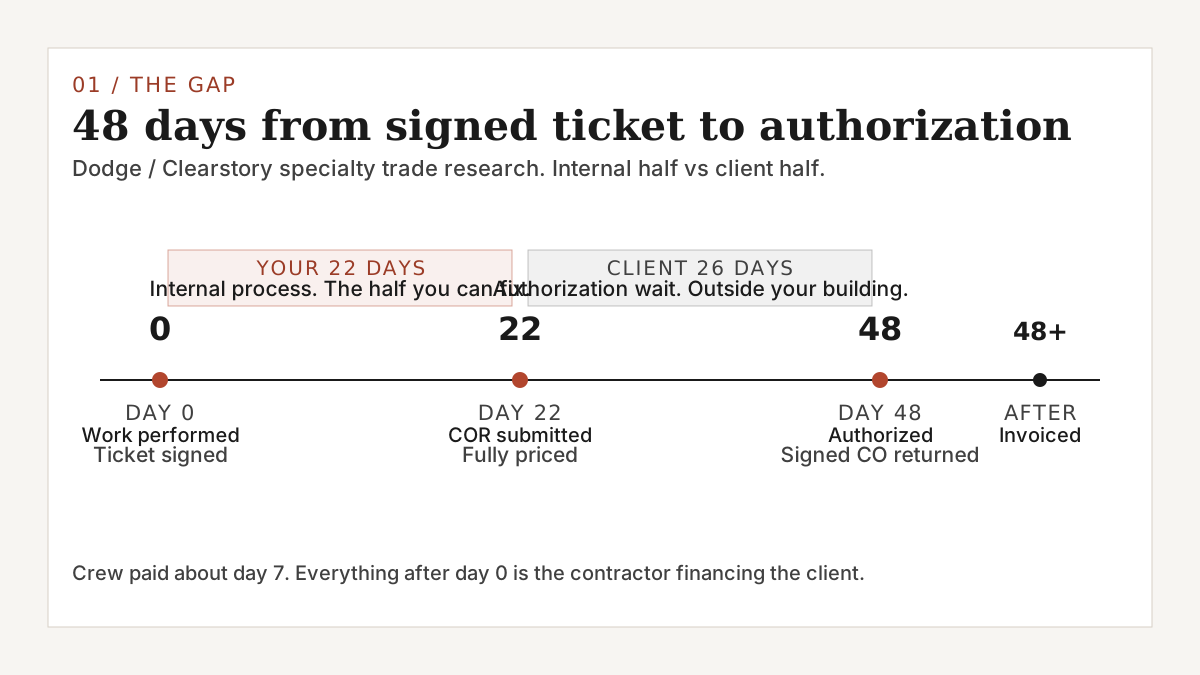
From a signed T&M tag in the field to a fully priced change order request submitted: 22 days on average. More than a third of contractors said their internal process takes three weeks or more.
Then from submission to a signed authorization coming back: another 26 days.
That is 48 days, on average, between a crew finishing billable work and anyone agreeing in writing that it will be paid for. The work was done on day zero. The crew was paid on day seven. Everything after that is the contractor financing their own client.
And the part that should genuinely alarm anyone running a T&M shop: in the same research, 77% of specialty contractors said they have written off change order work they were unable to collect. Not disputed. Not delayed. Written off. Work performed, never paid.
Eighty three percent said the process actively hurts their cash flow.
Here is the thing about that first 22 day number. It is entirely inside your own building. The client is not causing it. That is your own process, and it is the half you can actually fix.
So where do those 22 days go?
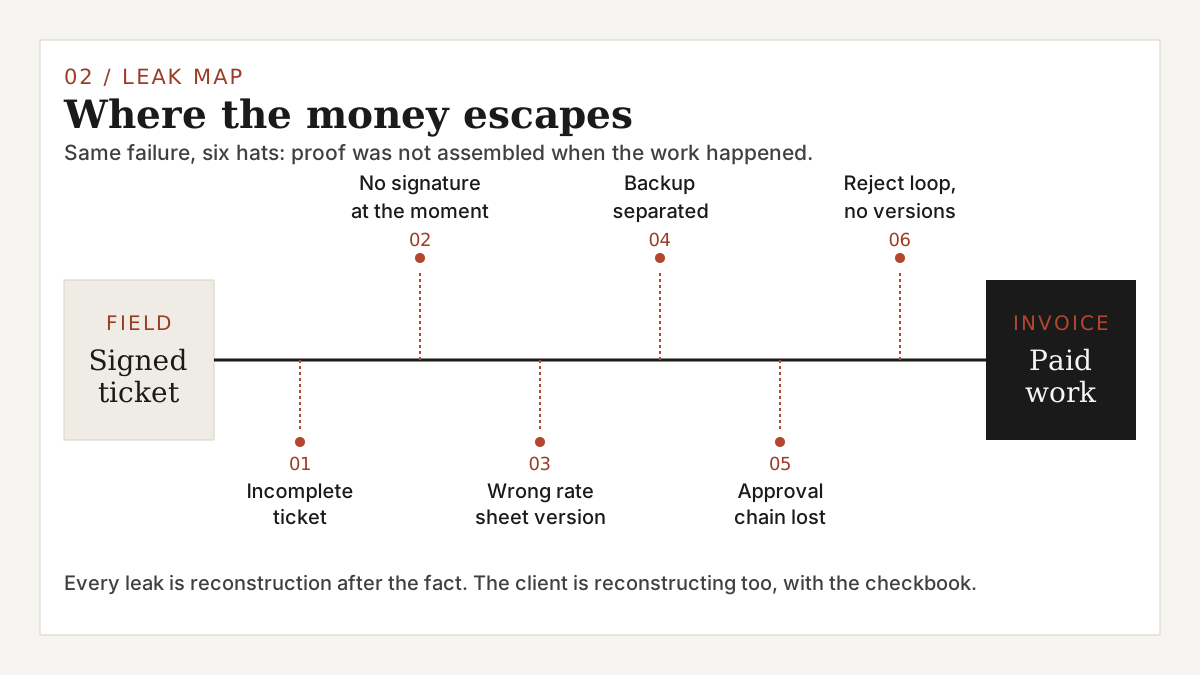
Six places T&M billing comes apart
1. The ticket is incomplete before it leaves the site
Handwritten tickets get written by someone whose actual job that day was the work, not the paperwork. Fields get skipped. Equipment gets left off because it was already on site. Quantities get estimated. Nobody notices until billing, weeks later, when the only available correction is a guess.
The cost is not the argument you lose. It is the line you never bill because you cannot substantiate it.
2. No client signature at the moment of work
A signature obtained three days later is a favor. A signature obtained at the moment of work is a fact. The distance between those two things is where most disputes live.
Crews avoid chasing signatures because it feels like asking for something. It is not. It is closing the record.
3. Rates come from the wrong version of the rate sheet
Most T&M rate sheets live in a spreadsheet, get revised mid contract, and exist in four versions with filenames ending in _final. Whoever prices the ticket picks one.
Pick wrong in the client's favor and you eat it. Pick wrong in yours and you have handed the client a reason to audit everything else you have ever submitted. The second outcome is worse, because it costs you the benefit of the doubt on every future ticket.
4. The backup gets separated from the invoice
The invoice goes to accounts payable. The photos are on a foreman's phone. The signed ticket is a PDF buried in an email thread. The daily report is in a different system entirely.
When the client asks for substantiation, someone spends half a day reassembling a package that should have existed as one object from the start. Meanwhile the invoice sits.
This is not a hypothetical drag. The FMI and PlanGrid Construction Disconnected study, which surveyed roughly 600 US construction leaders in 2018, attributed 48% of all US construction rework to poor project data and miscommunication, roughly $31.3 billion that year. The study is several years old and the number is industry wide rather than T&M specific, but the mechanism it describes has not changed. Information that is scattered gets recreated, and recreating it costs money.
5. Nobody can reconstruct who approved what
Approval on T&M work is a chain: crew chief, then superintendent or PM, then the client's rep. When each link is a text message, a verbal, or an email, the chain exists but cannot be produced on demand.
Disputes are rarely won on who was right. They are won on who kept the better record. A contractor who can show a timestamped approval sequence usually does not have to have the argument at all.
6. Rejection restarts the clock with no version history
A rejected ticket comes back with a comment. Someone fixes it and resubmits. Now two versions are in circulation and nothing records what changed between them. Rejected twice and the ticket is a month old and the person who wrote it has forgotten the job.
The reject loop is the most underestimated cost in T&M billing, because it is invisible in every report. Nothing tracks it.
The pattern underneath all six
Every one of these is the same failure wearing a different hat: the proof was not assembled at the moment the work happened.
Everything after that moment is reconstruction. Reconstruction is slow, it burns office hours, and it loses arguments, because the client is reconstructing their version too, and theirs is the one attached to the checkbook.
This matters more than it used to. Clearstory's 2025 survey of over 100 US trade partners found change orders and T&M work now account for 10 to 30% of a subcontractor's annual revenue. That is not a rounding error on the edge of the contract. For a lot of firms it is the difference between a good year and a flat one, and it is being managed with the least rigorous process in the company.
Meanwhile the payment environment is not helping. Rabbet's 2024 Construction Payments Report found 82% of contractors facing payment waits over 30 days, up from 49% two years earlier.
What actually fixes it
Not a better form. Not a stricter policy about turning tickets in on Friday. Both have been tried at every contractor in America and neither survives a turnaround.
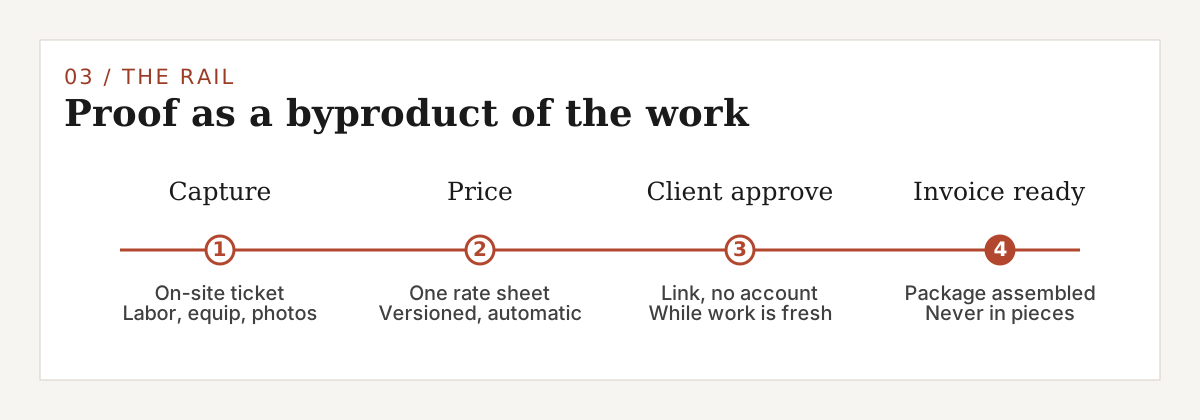
What fixes it is making the proof a byproduct of the work instead of a separate task performed afterward. Concretely:
- The ticket is created on site, on a phone, by the person who did the work
- Labor, equipment, materials, and photos land in one record, not four places
- Rates come from one managed rate sheet, applied automatically, versioned
- The client approves from a link, without an account, while the work is still fresh
- Every state change is timestamped, so the approval chain is a record instead of a memory
- The billing package assembles itself, because it was never in pieces
None of that shortens the client's 26 days. It attacks your 22.
One detail that surprises people
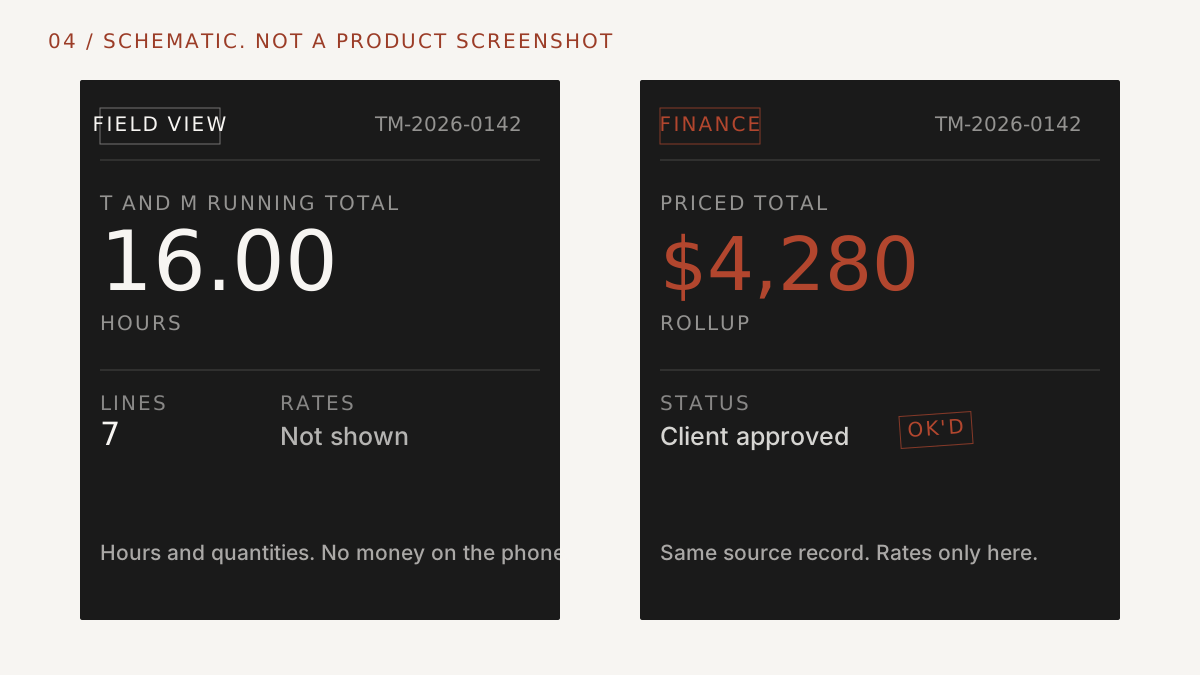
The crew should not see pricing.
That sounds like a small permissions decision. It is not. Crew chiefs enter hours and quantities. If they can also see rates and totals, three things happen. They start estimating toward a number instead of recording what occurred. The client's rep reads your margin over their shoulder on a phone screen. And your rate structure walks out the door with every foreman who leaves.
The same ticket should produce two documents. A field copy with hours and quantities and no money on it. A finance copy with the priced rollup. One source record, two views, nothing to reconcile between them.
Most systems treat this as a settings checkbox. It should be structural.
The honest framing
None of this is a novel observation. Clearstory, Aimsio, Rhumbix, HCSS, and a dozen others have built into this problem, and several of them are good at it. I have cited two of them above, because their research is the best available on this specific question. This is a contested category, not an empty one.
What remains unsolved for a lot of mid sized industrial and energy services contractors is not whether software exists. It is whether it matches how their crews actually work, whether it can be configured to their rate sheets and their client's approval habits without a six month implementation, and whether it produces a billing package their particular clients will accept without argument.
That is a narrower problem than "construction software." It is also the one worth solving.
FieldHarbor, a field to finance billing workflow for industrial, energy services, and specialty trade contractors who bill on time and materials.
Sources
- 0122 days average from signed T&M tag to fully priced COR submittedDodge Construction Network, Optimizing the Change Order Process for Specialty Trade Contractors (commissioned by Clearstory)2026
- 0226 days average from COR submission to signed change order returnedDodge Construction Network / Clearstory (same study)2026
- 0377% of specialty contractors have written off change order work they could not collectDodge Construction Network / Clearstory (same study)2026
- 0483% say the change order process negatively impacts cash flowDodge Construction Network / Clearstory (same study)2026
- 05Change orders and T&M make up 10 to 30% of a sub's annual revenueClearstory, 2025 Specialty Contractor State of Change Orders and T&M Work Report (100+ US trade partners)2025
- 0648% of US construction rework traces to poor project data and miscommunication (about $31.3B)FMI / PlanGrid, Construction Disconnected (about 600 US construction leaders)2018
- 0782% of contractors face payment waits over 30 days, up from 49% two years earlierRabbet, 2024 Construction Payments Report2024
Running a T&M shop and want a second set of eyes on the workflow? Request a workflow review.